
Hakuryu

Turning the European Space Agency's EarthCARE satellite into a dragon singing a song of peace to the earth.
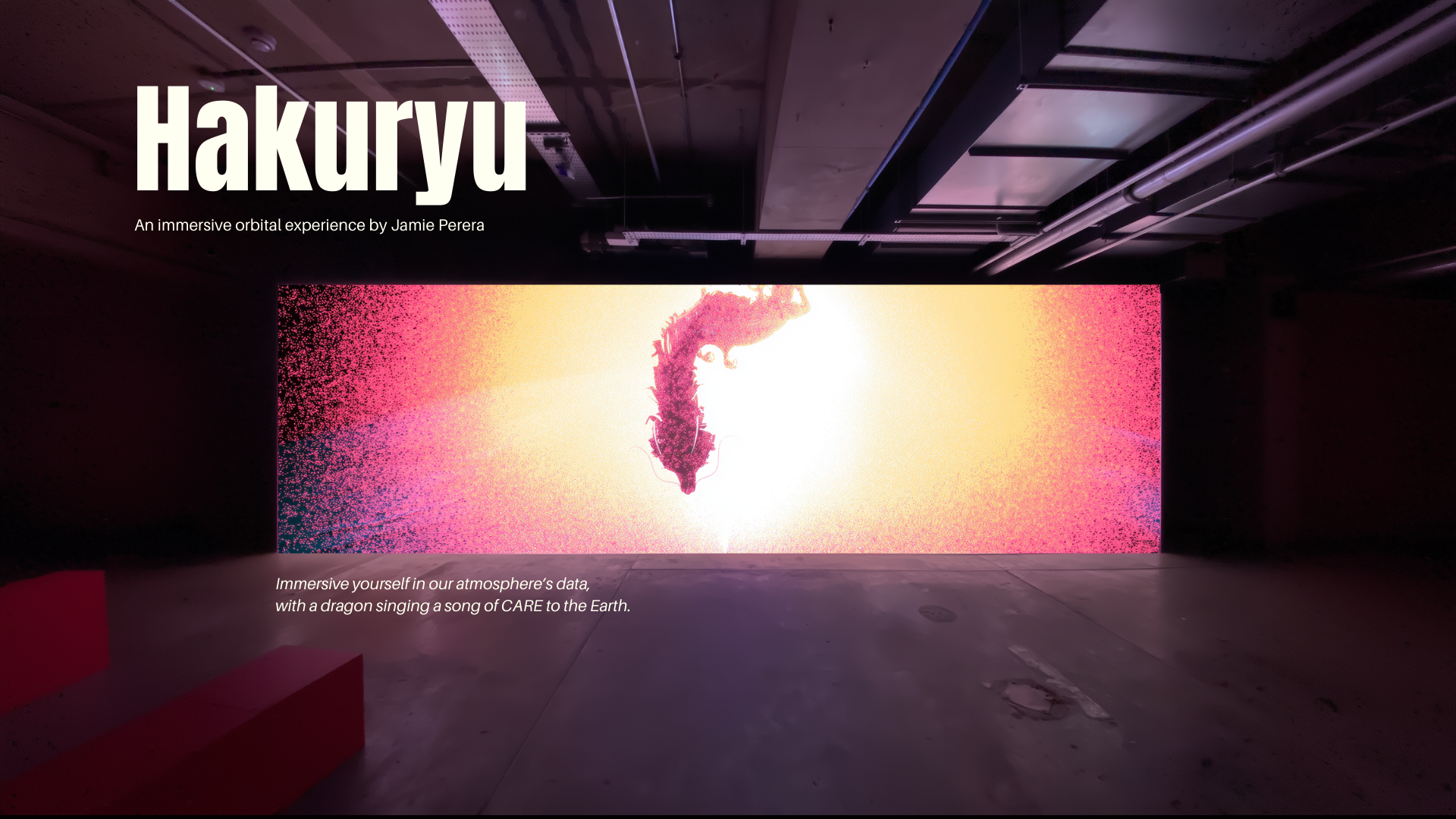

EarthCARE is ESA's most advanced Earth Explorer satellite launched to date, equipped with instruments that help us understand our climate in new and unprecedented ways. Similarly, Hakuryu is a groundbreaking immersive installation, that translates this planetary sensing into an audiovisual ecology, transforming over thirty types of EarthCARE data into a living landscape of sound and image.

With Hakuryu, atmospheric measurements become expressive, embodied forms. Clouds become choirs, with voices from notable public, scientific and ESA figures joined by those needing care most; people from the frontline of climate change, displacement and conflict. Data from atmospheric elements such as rain, snow, dust and smoke are rendered as rich textured sonic environments. Simultaneously the same data is transformed into cloud architectures, creating a vibrant trail behind an animated white dragon. Viewers will slowly fly with Hakuryu, in a beautiful representation of earth as it moves from day into night on its journey around the sun.

At its core, the installation poses a quiet but global question: “What does care on Earth look like to you?” As Hakuryu passes over each region of the planet, messages shared by participants worldwide surface within the work, weaving lived experience directly into the atmospheric fabric of the installation.

The combined effect is contemplative space of planetary listening, a moment to slow down, to dwell with Earth’s rhythms, and to imagine new forms of ecological care. Through its interlacing of science, testimony and immersive media, Hakuryu invites audiences into a renewed sense of connection with the fragile systems that sustain life on Earth, and ourselves as part of them.


Composed and produced by Jamie Perera

Sonification programming by Adrian Lewis

Data processing and aggregation by Daniel Santillan (EOX)

Film directed by Eric Trometer,

Film produced by Eric Trometer, Jamie Perera, Peter Bickerton & Tommaso Parrinello

Concept development by Peter Bickerton and Jamie Perera.


Links:

ESA article - The sound of Aeolus will blow you away

EJR Quartz article - Finding the sound of Earth’s winds


Audio: 

Performance guide: 

Sonification information: 

Timing:

In the 30 minute piece, each second is a day in the life of Aeolus – and the wind it measured as it orbited the globe 16 times a day.


Global tuning:

After careful consideration and experimentation with a few different modes, we chose Lydian mode with the root note of Bb (the lowest note played by an instrument at the moment is Bb1 on bassoon). We felt that the loss of accuracy moving from the chromatic scale to lydian mode was outweighed by the increase in accessibility, and would benefit listeners in terms of ear fatigue when listening to the whole piece.


Data to instrument considerations:

Data choices and assignments to instruments:

Data Instrument Midi Parameter Notes
Mean Rayleigh Wind Top Altitude Piccolo Note value (pitch) The tops of clouds seemed suitable for the highest instrument in the woodwind section.
STD Rayleigh Wind Top Altitude Velocity value (how hard note is played)
MIN Rayleigh Wind Top Altitude Note length (how long the note is played)
Mean Rayleigh Wind Observation Type Flute Note value (pitch) This is a value of how cloudy it is, feels to be high, but not as high as piccolo - therefore flute chosen
STD Rayleigh Wind Observation Type Velocity value (how hard note is played)
STD Rayleigh Wind Observation Type Note length (how long the note is played)
Mean Rayleigh Wind Reference Temperature Oboe Note value (pitch) Seems to complement wind velocity and pressure
STD Rayleigh Wind Reference Temperature Velocity value (how hard note is played)
MIN Rayleigh Wind Reference Temperature Note length (how long the note is played)
Mean Rayleigh Wind Velocity Clarinet 1 Note value (pitch) Seems an important core data type. Clarinet is a strong dependable core woodwind instrument
STD Rayleigh Wind Velocity Velocity value (how hard note is played)
MIN Rayleigh Wind Velocity Note length (how long the note is played)
Mean Rayleigh Wind Reference Pressure Clarinet 2 Note value (pitch) Seems an important core data type. Clarinet is a strong dependable core woodwind instrument
STD Rayleigh Wind Reference Pressure Velocity value (how hard note is played)
MIN Rayleigh Wind Reference Pressure Note length (how long the note is played)
Mean Rayleigh Wind Bottom Altitude Bassoon & bass clarinet Note value (pitch) The height of the earth at time of reading seems apt for the lowest ranged instrument e.g. bassoon. Reinforced with Bass clarinet
STD Rayleigh Wind Bottom Altitude Velocity value (how hard note is played)
MIN Rayleigh Wind Bottom Altitude Note length (how long the note is played)